- 1496 -
Leonardo da Vinci reminds us that even the best have stinkers sometimes by unsuccessfully testing one of his flying machines. The world would have been a different place if he had succeeded (but you could say that about most of his inventions).

Better luck with your spinning blades of death
- 1521 -
Pope Leo X excommunicates Martin Luther. Leo had handled the reformation very poorly. The notion of an idea being able to spread across the continent in a matter of months was a bit foreign at the time and so it’s understandable that Leo dithered for six months before gagging some monks and essentially driving Scandinavia to the Protestant side by using it as a Papal piggy bank.
It should be noted that Leo actually did have a white elephant . . . for no particular reason.
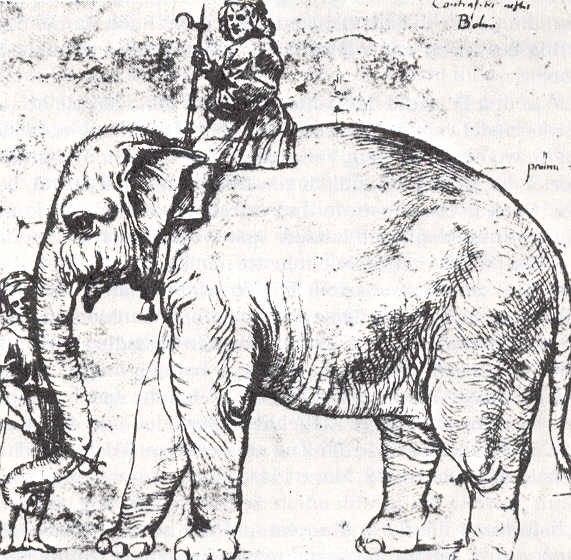
It would be the most robust popemobile until JP2 got his G-Wagen
- 1815 -
Austria, France and Great Britain signed a secret alliance against the Prussians and Russians (who were, at the time, everybody’s least favourite ‘ussians). This was a very odd alliance for the British and Austrians. France was seen by most to have instigated most of the wars (the Post-Revolutionary and Napoleonic Wars) which had marred the last three decades so was an odd bedfellow made palatable only by their new management. It was less than two months before Napoleon returned from exile for his Hundred Days and the French government needed all the friends they could get.
The British were motivated by concern about an increasingly militaristic Prussia (a trend which continued for the next century to its inevitable conclusion) and a deeply mistrusted Russia. Keeping Russia from becoming the dominant power in Europe was a priority for many nations at the time and wars like the Crimean War would be fought to keep them from ascendancy.
The January 3rd alliance was a big strategic manoeuvre between the allied powers while Russia and Prussia were both at the table at the Congress of Vienna (Sept. 1814 – June 1815). Although it was called a congress it was, in practice, just a long series of small meetings between foreign ministers, diplomats and heads of state. It was still revolutionary in that it was the first time all the European powers had come together to find peaceful resolutions to pressing international issues (which in this case meant dividing up the scraps of post-Napoleonic Europe).

Map of post-congress Europe included for anyone who cares.
During the congress France was in the worst bargaining position of all (much like Germany in 1918) so Foreign Minister Talleyrand-Périgord found himself aligning with the smaller players like Spain and Portugal to curb the ambitions of the big dogs in the yard (Austria, U.K., Prussia and Russia). Thanks largely to his efforts France came out of the negotiations if not unscathed, at least better off than their Teutonic counterparts would be left a century later.
The congress put in place a model of Europe that would remain almost completely unchanged until the First World War and was itself a model that the League of Nations would be based on. Although it didn’t work out well for everyone (Finland was to remain in Russian hands until 1917, The King of Sardinia quite fancied the Republic of Genoa because it was near some stuff he was getting back) it did guarantee safe travel up the Rhine and Danube Rivers as well as condemning slavery (for anyone who had missed that memo).
- 1956 -
The top of the Eiffel Tower caught fire. Strangely enough in December of the same year there was a fire in the ballroom of the Blackpool Tower Complex (a kind of low-budget English knock-off of the French one).

See, virtually identical
I don’t know what exactly there is to burn at the top of the Eiffel Tower (or where the fire would pose a danger of spreading to) but apparently the same thing happened in 2003.
- 1962 -
Pope John XXIII excommunicated Fidel Castro. I won’t comment on whether or not it “works” but excommunication is basically when the Pope tells someone to fuck off. In which case: well done, John.

1962
ReplyDeletehear hear John XXIII